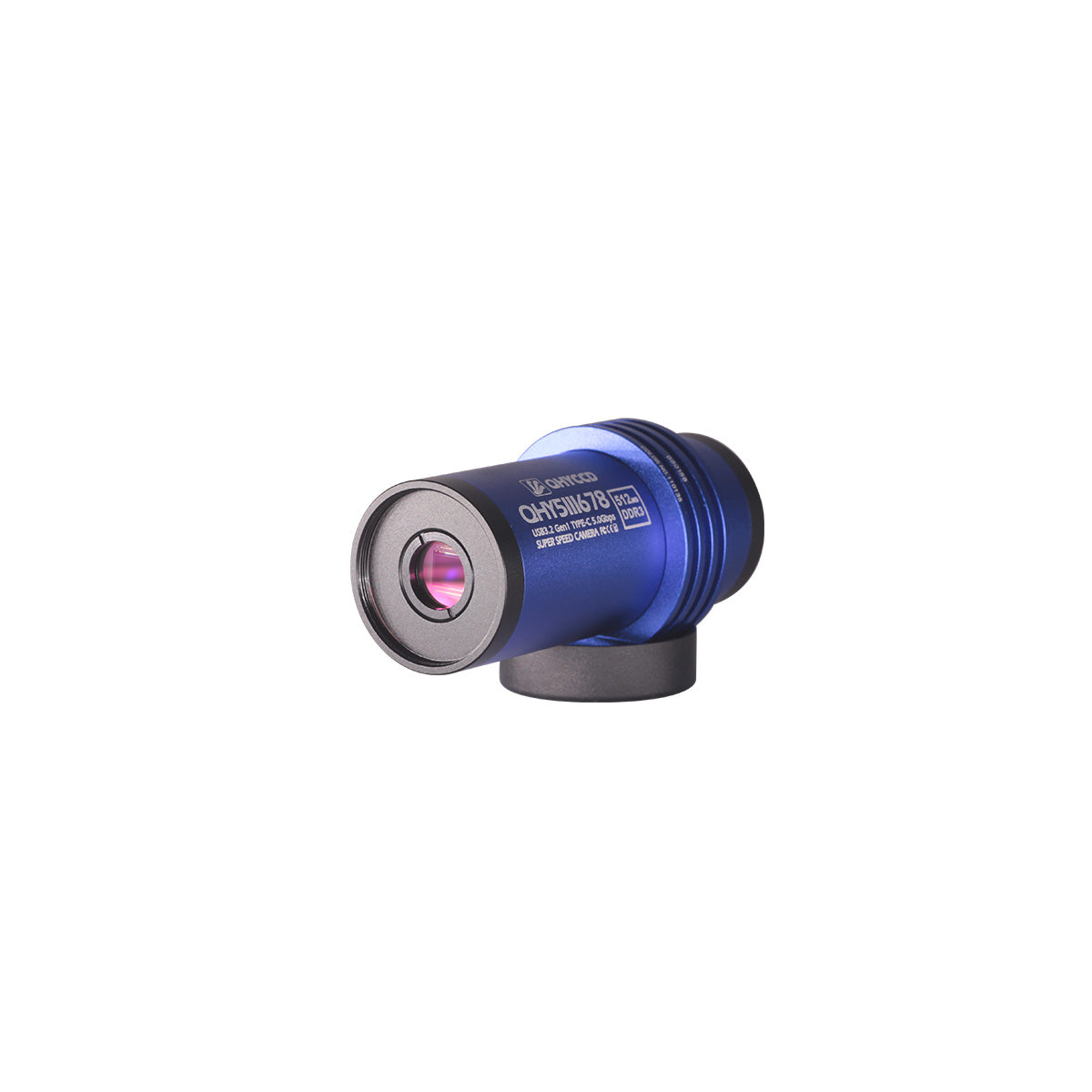
QHY5III678 Colour Camera
QHY
Couldn't load pickup availability
Share
Overview
QHY5III678M/C, the upgraded version of QHY5III 178M/C, is a new planetary and guiding camera of QHY5III V2 series with excellent near-infrared high sensitivity.
Extended Near Infrared Sensitivity
In this latest generation of sensors, the photodiode portion of the pixel well is physically deeper than in previous sensors, allowing photons of longer wavelengths to penetrate further into the substrate. This dramatically increases the sensor's sensitivity to red and near-infrared (NIR) light. The sensor exhibits nearly equal peak sensitivity to NIR light as it does to visible light.
512MB DDR3
The QHY5III (Ver. 2) series planetary and guiding cameras are all equipped with a 512MB DDR3 image buffer which can effectively reduce the pressure on computer transmission, a great help for planetary photography which often requires writing a large amount of data in a short period of time. Some deep-sky astrophotography cameras on the market today only have 256MB, for example.
In comparison, the 512MB DDR3 memory of the new 5III (Ver. 2) series cameras represents a significant upgrade.
New Front-end Desn with Better Compatibility
QHY5III (Ver. 2) series cameras have adopted a new front-end design with improved compatibility.
The BFL (back focal length) of a V2 camera is only 8mm, which means you can easily integrate a V2 camera with your OAG (off-axis guider). The basic top adapter includes 1.25-inch threads, so you can still use your 1.25-inch filters.
The top adapter glass of the V2 can be easily swapped. One of the advantages of interchangeable top glasses is that you can use a filter even if you’re using a lens! You can add a 1.25-inch to CS adapter to connect a CS lens, or add a second CS-C adapter for a C-mount lens. Both adapters are standard accessories for V2 cameras.
Additionally, there’s a 1.25-inch filter wheel adapter available to connect your monochrome planetary camera to the QHYCFW3-S filter wheel.
USB 3.2 Gen1 Type C Interface
The new QHY5III (Ver. 2) series cameras all use the USB 3.2 Gen 1 Type-C interface. Compared to the USB 3.0 Type-B interface used in the previous generation, the Type-C interface offers a longer lifespan and greater flexibility.
Tip: It is recommended to use the official QHYCCD standard Type-C data cable. Since the market is flooded with a large number of poor-quality Type-C cables, using an inferior cable may cause the camera to malfunction. If you choose to use your own cable, please ensure it is of high quality.
Universal Guiding Interface
The custom interfaces used in the previous generation of planetary cameras and guiders have been replaced in the QHY5III (Ver. 2) cameras with a more universal ST-4 compatible guiding interface. Now, even if the guiding cable is lost or damaged, you can easily find a replacement on the market at a low cost.
Indicator LED
The new QHY5III (Ver. 2) series cameras are equipped with a status indicator at the back of the camera. If the camera experiences an abnormal condition, the coloured indicator light will help diagnose the issue, with different colours signifying different statuses. During normal operation, the indicator light is off, so there’s no need to worry about light contamination in the image.

Specifications
| Attribute | Details |
|---|---|
| Model | QHY5III678M/C |
| Image Sensor | Sony IMX678 |
| Mono/Color | Both Available |
| FSI/BSI | BSI |
| Sensor Size | 1/1.8 inch |
| Pixel Size | 2.0μm x 2.0μm |
| Effective Pixel Area | 3856 x 2180 |
| Effective Pixels | 8.4 Megapixels |
| Full Well Capacity | 9ke- |
| Read Noise | 0.57e- to 3.3e- |
| A/D | 12-bit (output as 16-bit and 8-bit) |
| Built-in Image Buffer | 512MB DDR3 Memory |
| Full Frame Rates | 43FPS@8bit, 22FPS@16bit |
| ROI Frame Rates | 1080Lines, 85FPS@8bit, 43.5FPS@16bit 640Lines, 140FPS@8bit, 71FPS@16bit |
| Exposure Time Range | 11μs - 900sec |
| Shutter Type | Electronic Rolling Shutter |
| Computer Interface | USB3.0 Type-C |
| Guide Port | Standard ST-4 Style |
| Telescope Interface | 1.25-inch, with CS and C-Mount |
| Optical Window | AR Anti-reflection Glass (5III678M) IR-Cut filter (5III678C) |
| Extra Filter | IR850nm Filter Included |
| Back Focal Length | 17mm (with adapter); 8mm (without adapter) |
| Weight | 90g |
Let customers speak for us
from 184 reviewsI'm happy with this product. Good price, good quality, and does the job required.
The 50mm SuperView (Erfle) eyepiece in a long focal length telescope gives a big, wide view of the sky that shorter eyepieces can't do. Coupled with an 8 inch f/12 Cassegrain, it gives a 1.2° field of view. The entire Moon fits easily in the view, as does most of the Pleiades/Matariki and the Orion Nebula.
For contrast, a 32mm Plossl has only about 0.5° field of view in the same telescope.
It's very easy and comfortable to look through, with plenty of eye relief even wearing glasses. Some eyepieces can be really particular with where you need to place your eye, but this isn't one of them.
If I had to pick a fault for it, it's a little lacking in contrast, but considering the price, it's extremely minor.
TL/DR: If you have a long focal length telescope, you should have one of these, and for $140, you don't have an excuse not to.
Weather and work mean I haven't yet had a chance to try out the coma corrector under the stars, but based in my short experiments with viewing tree branches about 150 m distant from my telescope, it looks like this coma corrector is doing a good job at bringing the entire field of view into focus. This is with a 10" F4.7 Newtonian, and with a full frame (35 x 24 mm) camera. Note that this corrector is a rebranded GSO come corrector (I don't think AstroNZ will mind me saying that), and so it does need 70-80mm back focus (so you'll likely need 20 to 30 mm M48 extension rings depending on what you're doing), and despite what the website says, it does also lengthen the scope focal length by a factor of ~ 1.1, so you lose a bit of field of view, but not much.
All in all for the price, I think this is pretty good value, and a great place to start you want to sharpen the stars across the field of view.
I haven't had a chance to try it yet, as it's a present for my son for Christmas, but Andrew was super helpful when buying!
I was purchasing a weight for my ioptron tracker when I saw this tripod and I decided to purchase it as well to give my tracker its own dedicated tripod.being that this one was designed for my to be used on it it was a no brained. I have only used it once so far but it is wonderful and was easy to fit my tracker to. Very satisfied customer
Rechargeable is great. Handy size for pocket, and exceptional pointing in daylight conditions up to 60 odd meters.
Binoculars were easy to set up/focus for my eyesight (wearing glasses). Bundled instructions were easy to follow. Image is crisp and clean when focussing on distant objects(in daytime). Now just need some clear skies so can try them out at night.
A very convenient device for those times when you want to see the sun (or something very bright) and you want to still be able to see afterwards.
Easy to carry as it is small and flat.
Great scope, great accessories, but most importantly the best customer service I've ever seen from any business.
These arrived quickly and were exactly what we needed for seeing the partial solar eclipse! The flat cardboard rectangle ones are great if you wear glasses and find it hard to wear the goggle/glasses shaped ones, these flat ones you just hold up in front of your glasses and they are perfect :)
Arrived within 24 hours (amazing) as we ordered late. I appreciate that they are made to the ISO standard. Thanks!
Appears to be same model as the GSO brand on Aliexpress. Astronz price is same as if not better - shop local. Work fine on my short focus refractor.
Astronz 08" Premium Dobsonian Telescope